Undergraduate Research in the Comito Group
Mentorship and Professional Development
Student researchers will learn research fundamentals including scientific communication, recordkeeping, problem solving, and analytical reasoning, as well as chemistry-specific techniques like characterization, synthesis, and modelling. Undergrads are initially paired with an experienced graduate student, but receive regular mentorship from Professor Comito through appointments and weekly group meetings. Students are expected to maintain a laboratory notebook, for which we use the electronic platform LabArchives. They present their progress through the notebook at group meetings, allowing discussion of not just research results, but also observations and technical details. Students present their research in PowerPoint presentations once a year. All students are encouraged to publish and to attend conferences. In his independent career, Professor Comito has mentored eleven UH undergraduate students and three high school researchers. Those mentees have successfully pursued medical school, graduate school, military comission, and employment.
Funding
UH students in my lab have received scholarships from the Summer Undergraduate Research Fellowship (SURF), the Provost Undergradaute Research Scholarship (PURS), and the Energy Scholars programs. Recent application deadlines for these programs have been as follows: SURF, March 13, 2026; PURS, November 2, 2026; Energy Scholars, November 2, 2026. Grant funding may be available for paid summer internships. But grant funding will be prioritized for experienced students who have already completed a semester on a volunteer or scholarship basis.
Commitment and Eligibility
Time commitment: At least ten hours per week and one weekly group meeting during the academic year. Applicants should be available for at least one full year of research (two regular semesters). Preference will be shown to students who commit to one full-time paid summer internship (~10 weeks, 40 hrs per week). Seniors graduating in less than a year will only be considered if they have prior research experience in chemistry or a chemistry-adjacent discipline. Leaves of absence are granted for finals and MCAT preparation.
Coursework: Students must have a STEM major whose degree plan includes organic chemistry and organic chemistry lab. It is okay if these courses have not been completed yet, but students should plan to take them. Successful applicants will have a strong record of academic success and a high GPA.
Premedical Students
Professor Comito has mentored several premedical students at UH, two of which have successfully been admitted to medical schools. Compared with other career tracks, premedical students can expect focused projects that emphasize depth and fundamental skills over breadth of laboratory techniques. Those fundamentals include critical thinking, communication, and rigor that are valued in medical professions and covered in my letters of recommendations. Nevertheless, premedical students should show a strong commitment to research and a realistic understanding of how it will advance their career.
How to Apply
Interested applicants should contact Professor Comito by email (rjcomito@central.uh.edu). Applications should include (1) full resume or curriculum vitae, and (2) current transcript (unofficial is okay). Your email should also list (1) your intended semester of graduation, (2) your major, and (3) your availability for summer research. Premedical students and applicants without chemistry-adjacent majors should briefly explain why they want to do research in chemistry and how they are qualified.
Undergraduate Project Opportunities
This section describes some of the types of projects that undergradaute students can expect to have in the Comito group. Project details will depend on unpublished results that will not be advertised publically. The goal in this section is to describe the techniques undergraduate students can apply and the skills that they will learn.
Computational Modelling
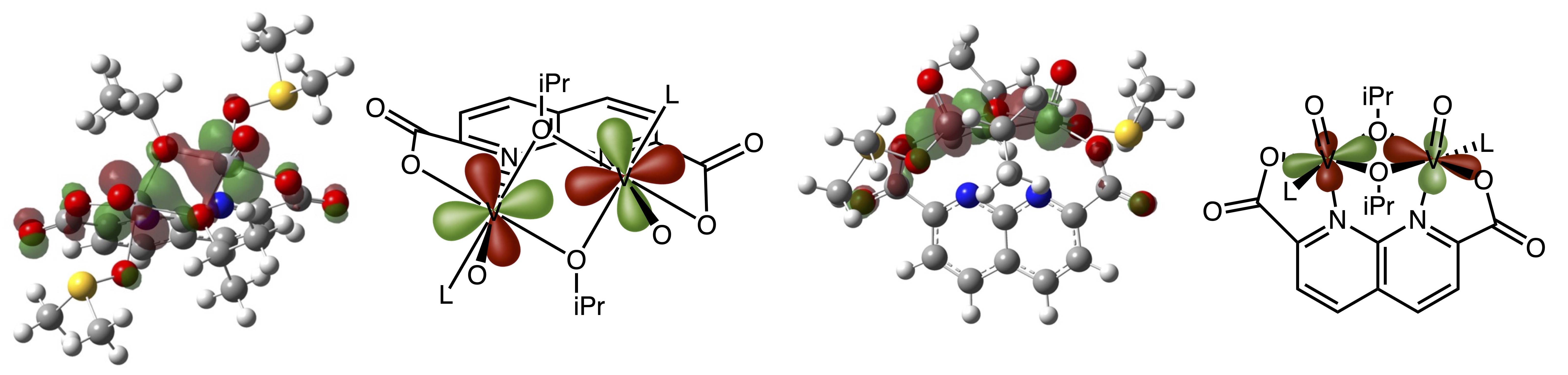
Our laboratory uses density functional theory (DFT) for computational chemistry. Students on this project will learn Gaussian, command line programming, physical chemistry, and molecular visualization. Our laboratory uses DFT to predict the strucutre of metal complexes, the mechanism of reactions, and physical properties of intermediates that cannot be isolated for analysis. The image above shows molecular orbitals on a divanadium complex we made, visualized using Kohn-Sham DFT. Computational students can contribute to variety of projects in the Comito laboratory. This is the only project that can be completed remotely.
Lignin Extraction
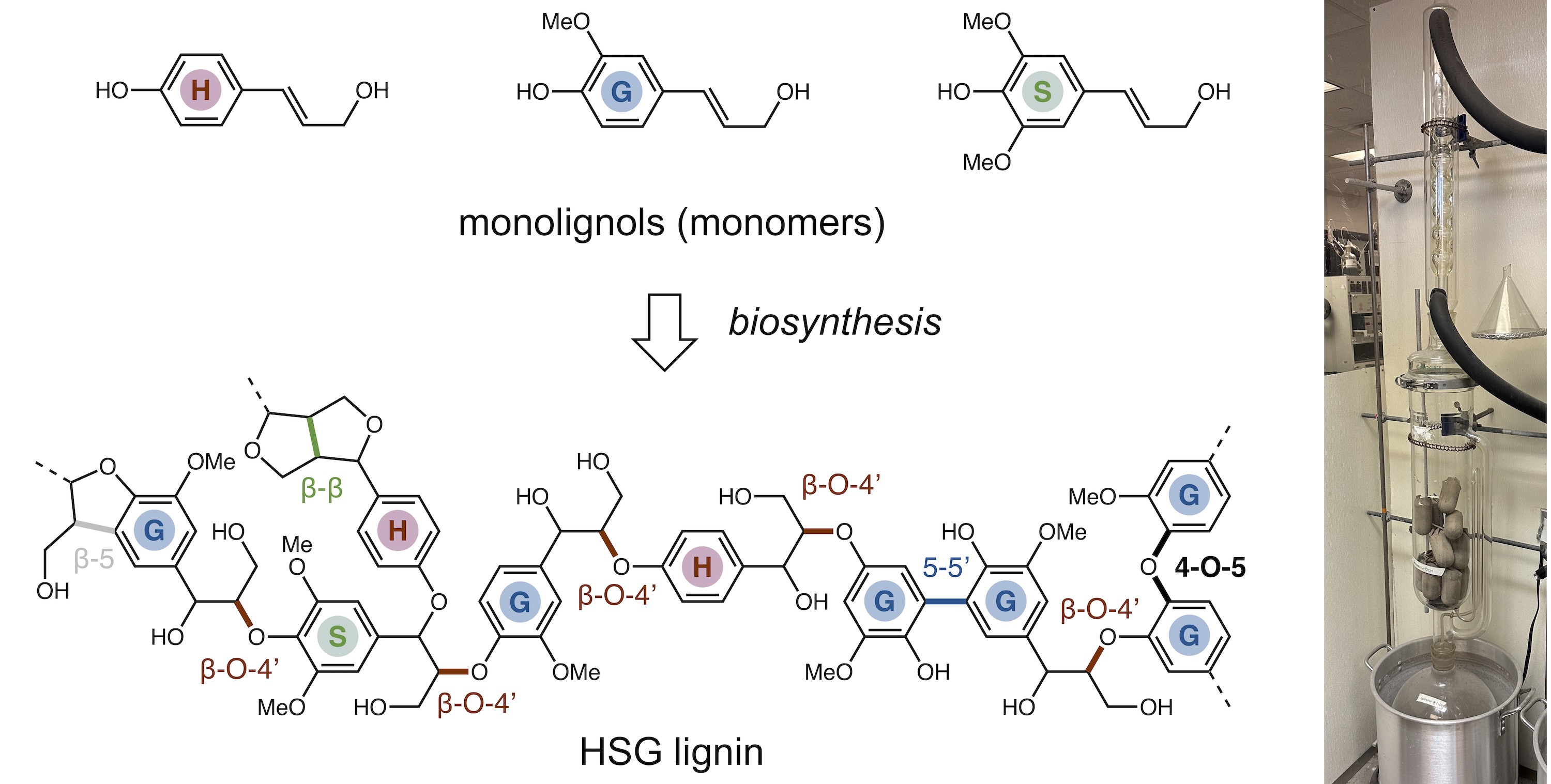
Our laboratory develops catalysts for the oxidative depolymerization of lignin into commodity chemicals. Lignin is a major component of woody biomass that has few commercial uses. This project aims to improve the economics and sustainability of biomass industries. The extraction, characterization, and derivatization of lignin are done in house because commercial lignin samples are heavily degraded. Students on this project will learn Soxhlet extraction, infrared spectroscopy, gas chromatography, gel permeation chromatography, and advanced NMR techniques. This project will prepare students for careers in chemical industry and in energy, and may be a good fit for engineers.
Catalysis
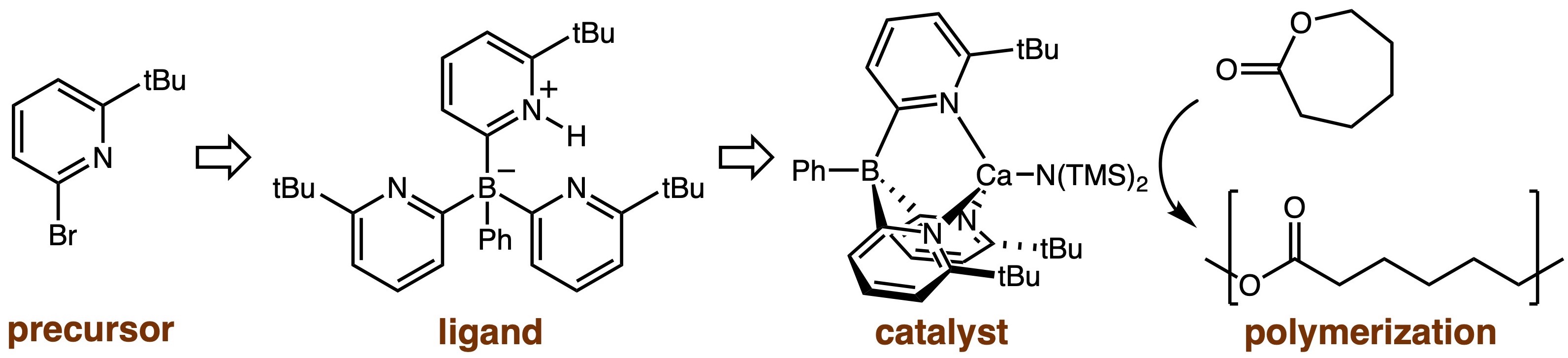
Our laboratory designs new catalysts for polymerization and depolymerization. Catalyst synthesis starts with the preparation of organic ligands. Ligand synthesis entails reaction chemistry, workup procedures, isolation (chromatography, crystallization, and sublimation), and organic characterization (1H NMR, 13C NMR, IR spectroscopy, and mass spectrometry). Catalysts are then prepared by metallation, and then have to be characterized by inorganic techniques (X-ray crystallography, elemental analysis). Finally, polymerization reactions are carried out on monomers like lactide and epsilon-caprolactone. The polymeric products are characterized by gel-permeation chromatogrpahy, NMR, and MALDI. This project type is ideal for students interested in research careers, and especially in chemistry graduate school, because it covers a wide range of chemistry laboratory techniques. These techniques are nevertheless scaffolded, such that a student can focus on the ligand synthesis and only progress to later project stages after mastering those methods. However, I have also had premedical students focus entirely on ligand synthesis. This project will also prepare students for careers in the chemical industry.
Synthetic Methodology

The goal of this type of project will be to develop an organic chemistry reaction for use in medicinal chemistry or complex molecule synthesis. We are not directly studying the application of the molecules that we are making, but the art of synthesis. The project will entail reaction discovery and development, in which hypotheses about organic reactivity will be tested and refined. Then the scope of the reaction will be worked out through iterative applications on varying substrates. Finally, the mechanism of the reaction will be worked out using control experiments and physical organic chemistry techniques. This project is ideal for students interested in research careers and in graduate school, since chemical synthesis is widely useful in molecular sciences. It is also good experience for the pharmaceutical industry and for medicinal chemistry research.
Chemical Education

Professor Comito has a strong interest in teaching innovation, and has published research on new pedagogical methods developed in his class. Undergraduates on this project would work to translate some of the Comito laboratory's research interests into teaching laboratory activities. This endeavor will require adapting experimental protocols from the research laboratory to the teaching laboratory setting. Once developed, implementation will require preparing course materials, developing surveys, and preparing content tests to evaluate teaching effectiveness.